← All work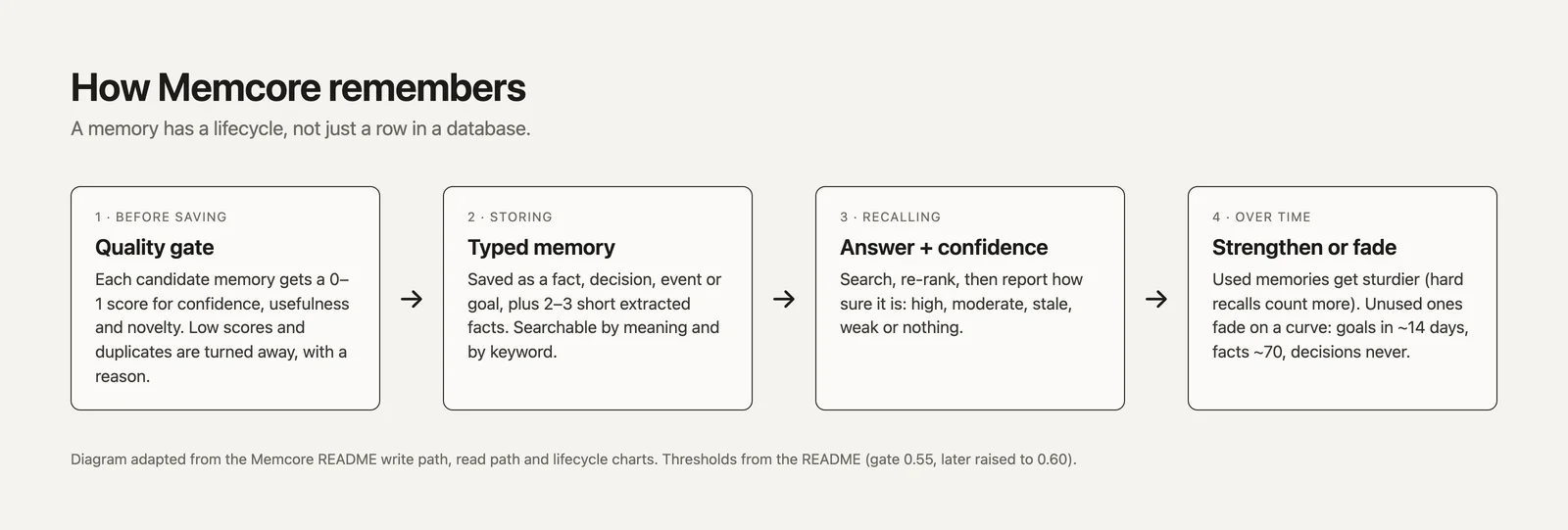
Great at finding one fact. Harder across conversations.
Own project · AI research · 2026
Memcore
AI memory that works more like a brain
- Role
- Solo research + build
- When
- Apr – May 2026
- Built with
- Python, Postgres, MCP
- Status
- Paused, open source
- 4,129
- memories from real work
- 100%
- single-conversation recall
- 5.7%
- of recalled memories used
The before
Every AI conversation started from zero. The memory tools I found were just search boxes.
What I built
Memory that saves carefully, rates its confidence, and forgets.
Features
01Keeps what's worth it
Duplicates and low-value chatter never get saved.
02Memories fade
Decisions stay forever, and other memories fade unless they keep getting used.
03Says when it's guessing
Every recall comes back with a confidence level.
Why it matters
- Single-conversation questions100%
- Fresh mixed sample70%
- Questions spanning many conversations50%
Source: LongMemEval samples of 20–50 questions, May 2026. Not the full leaderboard.
The lesson: it was confident 92% of the time, but only 5.7% got used.
How it works
- You ask Claude something
- Memcore recalls
- Claude answers
- Used memories get stronger
- Unused ones fade
It plugs into Claude Code, recalls before each prompt, and checks what got used.
Technical details +
What I found
- Small samples lie. A +8 point win became a loss at 50.
- Shorter answers pleased the AI judge but failed strict grading.
Stack
- Python + MCP server
- PostgreSQL + pgvector
- Cross-encoder reranking
- Docker on my homelab
What I learned
- —Measure what gets used, not what looks confident.
- —Benchmarks and real work differ. Most real prompts are short follow-ups.
Building with AI memory? I'd love to compare notes.